





Hey there! As a supplier of TO-220 Cool Voltage MOSFETs, I often get asked about the thermal resistance of these nifty little components. So, I thought I'd take a moment to break it down for you in plain English.
First off, let's talk about what thermal resistance actually is. In simple terms, thermal resistance is a measure of how well a material or component can resist the flow of heat. It's kind of like how a thick winter coat resists the flow of cold air. The higher the thermal resistance, the more difficult it is for heat to pass through.
Now, why is thermal resistance important for MOSFETs? Well, MOSFETs (Metal-Oxide-Semiconductor Field-Effect Transistors) are semiconductor devices that are used to switch or amplify electronic signals. When a MOSFET is in operation, it generates heat due to the electrical current flowing through it. If this heat isn't dissipated properly, it can cause the MOSFET to overheat and eventually fail. That's where thermal resistance comes in. By understanding and managing the thermal resistance of a MOSFET, we can ensure that it operates within a safe temperature range and has a long lifespan.
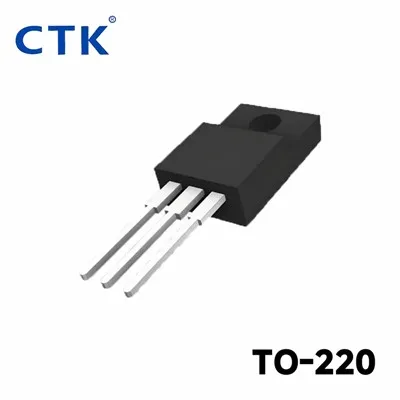
So, what is the thermal resistance of TO - 220 Cool Voltage MOSFETs? The thermal resistance of a TO - 220 package MOSFET is typically specified in two main parameters: RθJC (junction - to - case thermal resistance) and RθCA (case - to - ambient thermal resistance).
RθJC is a measure of how well heat can transfer from the semiconductor junction (where most of the heat is generated) to the metal case of the MOSFET. This value is mainly determined by the internal structure of the MOSFET, such as the thickness and thermal conductivity of the die - attach material and the semiconductor substrate. For TO - 220 Cool Voltage MOSFETs, the RθJC value is usually in the range of 1 to 2 °C/W. This means that for every watt of power dissipated in the MOSFET, the temperature of the junction will rise 1 to 2 degrees Celsius higher than the temperature of the case.
RθCA, on the other hand, measures how well heat can transfer from the metal case of the MOSFET to the surrounding ambient air. This value depends on factors like the surface area of the case, the airflow around the MOSFET, and any heat - sinking devices (like heatsinks or fans) that are used. Without any additional heat - sinking, the RθCA of a TO - 220 MOSFET can be quite high, often around 60 - 80 °C/W. However, when a proper heatsink is used, the RθCA can be significantly reduced, sometimes down to a few degrees Celsius per watt.
Let's take a look at an example to see how thermal resistance affects the temperature of a MOSFET. Suppose we have a TO - 220 Cool Voltage MOSFET that is dissipating 5 watts of power. If the RθJC is 1.5 °C/W and the RθCA is 20 °C/W (with a simple heatsink), and the ambient temperature is 25 °C.
First, we calculate the temperature rise from the junction to the case: ΔTJC = P × RθJC, where P is the power dissipated. So, ΔTJC=5W×1.5°C/W = 7.5°C.
Next, we calculate the temperature rise from the case to the ambient: ΔTCA = P × RθCA. So, ΔTCA = 5W×20°C/W=100°C.
The total temperature of the junction (Tj) can be found using the formula Tj = Ta+ΔTCA + ΔTJC, where Ta is the ambient temperature. So, Tj = 25°C+100°C + 7.5°C = 132.5°C.
As you can see, the thermal resistance plays a crucial role in determining the temperature of the MOSFET. If the junction temperature exceeds the maximum rated temperature of the MOSFET (usually around 150 - 175 °C), the MOSFET may start to degrade or even fail.
Now, as a supplier of TO-220 Cool Voltage MOSFETs, I know how important it is to choose the right MOSFET for your application. When selecting a TO - 220 Cool Voltage MOSFET, you need to consider not only the electrical characteristics (like voltage rating, current rating, and on - resistance) but also the thermal characteristics. Make sure to check the datasheet for the RθJC and RθCA values, and calculate whether the MOSFET can handle the power dissipation in your specific application without overheating.
If you're not sure which TO - 220 Cool Voltage MOSFET is right for you, don't worry! We have a team of experts who can help you choose the best component for your needs. We offer a wide range of TO - 220 Cool Voltage MOSFETs with different electrical and thermal specifications, so you're sure to find the perfect fit for your project.

Whether you're working on a small DIY electronics project or a large - scale industrial application, our TO - 220 Cool Voltage MOSFETs are designed to provide reliable performance and efficient heat dissipation. We use high - quality materials and advanced manufacturing processes to ensure that our MOSFETs have low thermal resistance and high thermal stability.
So, if you're in the market for TO - 220 Cool Voltage MOSFETs, why not get in touch with us? We'd be more than happy to discuss your requirements and help you find the right solution for your project. Whether it's about understanding the thermal resistance or any other technical details, we're here to support you every step of the way.
In conclusion, thermal resistance is a critical factor to consider when using TO - 220 Cool Voltage MOSFETs. By understanding how it works and how to manage it, you can ensure the reliable operation and long lifespan of your MOSFETs. And if you need any help or have any questions, just reach out to us. We're here to make your electronics projects a success!
References
- "MOSFET Handbook", International Rectifier
- Various MOSFET datasheets from leading semiconductor manufacturers