





If you’ve ever knelt over a workbench at 2 a.m., soldering tiny parts into a power supply that needs to fit into a laptop charger, a smartwatch, or a medical device that’s smaller than a credit card, you know how much of a headache component selection can be. The wrong capacitor can add bulk. The wrong resistor can throw off your voltage regulation. And when it comes to zeners—those tiny workhorses that keep voltage stable by breaking down in reverse bias—there’s always the same question: do SOD-323 zener diodes for compact voltage control actually work for power supplies? As someone who’s spent the last 12 years working with diodes for power management, I’ve fielded this question at trade shows, in DMs from engineers stuck on a prototype, and over coffee with a colleague who had a product delayed by choosing the wrong zener package. Today, I’m breaking down exactly whether these small SOD-323 zeners belong in your next power supply design, based on real-world performance, use cases, and the limits you can’t ignore.
First, let’s get one thing straight: not all zeners are created equal. A lot of newer designers look at a SOD-323 package, shrug, and assume it’s too small for power supplies, which need to handle current and heat. That’s a fair first thought—power supplies deal with consistent current draw, and heat is the enemy of any semiconductor. But SOD-323 zener diodes aren’t just tiny; they’re designed specifically for applications where board space is non-negotiable. If you’re building a power supply for a portable Bluetooth speaker, a handheld diagnostic tool, or a compact USB-C charger, SOD-323’s 2.5mm x 1.2mm footprint is a game-changer, because it frees up space for bigger capacitors or more processing power that you’d otherwise have to sacrifice for a larger component.
That said, the biggest misconception I see is that “compact” equals “low-power.” To answer the core question, we have to split power supplies into two buckets: low-current, compact power supplies, and high-power, industrial-grade power supplies. SOD-323 zeners work phenomenally well for the first bucket, and they’re a risky fit for the second. Let’s dig into why.
First, let’s talk about the specs that matter most for zeners in power supplies: power rating, reverse leakage, and thermal performance. SOD-323 zener diodes typically have a power rating of 0.5W at 25°C, which might sound small, but that’s perfect for most low-power power supply applications. A USB-C wall charger that outputs 15W, for example, runs at around 3A max at 5V, so the zener only needs to handle small fluctuations in voltage, not constant high current. Reverse leakage is another key spec here—leakage current is the tiny amount of current that flows through the zener when it’s reverse-biased below its breakdown voltage, and high leakage can throw off the voltage regulation in low-power circuits. SOD-323 zeners are designed to minimize this, with modern silicon planar construction that keeps leakage low even at low voltages, which is critical for sensitive electronics like sensors or display drivers.

But here’s where the limits start: thermal performance. Because SOD-323 is a surface-mount package with small leads, it doesn’t dissipate heat as well as larger packages like LL-41 or SOD-123. If you’re using a power supply that outputs 50W or more, the current draw and heat will cause the SOD-323 zener to overheat, leading to unstable voltage, shortened component life, or even failure. For those high-power applications, you’ll want to look at larger packages, like the LL-41 silicon planar power zener diodes, which are designed to handle higher power ratings (up to 1.5W or more) and have better thermal dissipation for heavy current loads. That’s not to say SOD-323 can’t ever be used for slightly higher current—just that you have to derate it, and check your application’s maximum current draw carefully.
I’ve seen this play out first-hand with a customer of mine, a startup that was building a compact portable oxygen concentrator for home use. They initially tried using SOT-23 zener diodes for voltage regulation, but those were too big to fit their small battery compartment, so they switched to SOD-323 zeners. The first prototype worked great for light use, but when the device was used for extended periods, the zener would get hot and cause the output voltage to drop. We worked with them to adjust their design: they added a small heat pad under the zener and adjusted the current limit on their power supply, and the issue was resolved. It was a perfect example of how SOD-323 works, as long as you understand its limits, rather than trying to treat it like a higher-power component.
Another factor that makes SOD-323 zener diodes for compact voltage control a good fit for many power supplies is their ease of integration into modern SMT assembly lines. Most contract manufacturers are set up to handle SOD-323 packages, which are standard surface-mount parts, so there’s no extra cost or complexity in assembly. Compare that to older through-hole diode packages, which require manual soldering and add time to production. For high-volume power supply manufacturing, that’s a huge benefit—lower assembly costs mean a better end product for the customer.
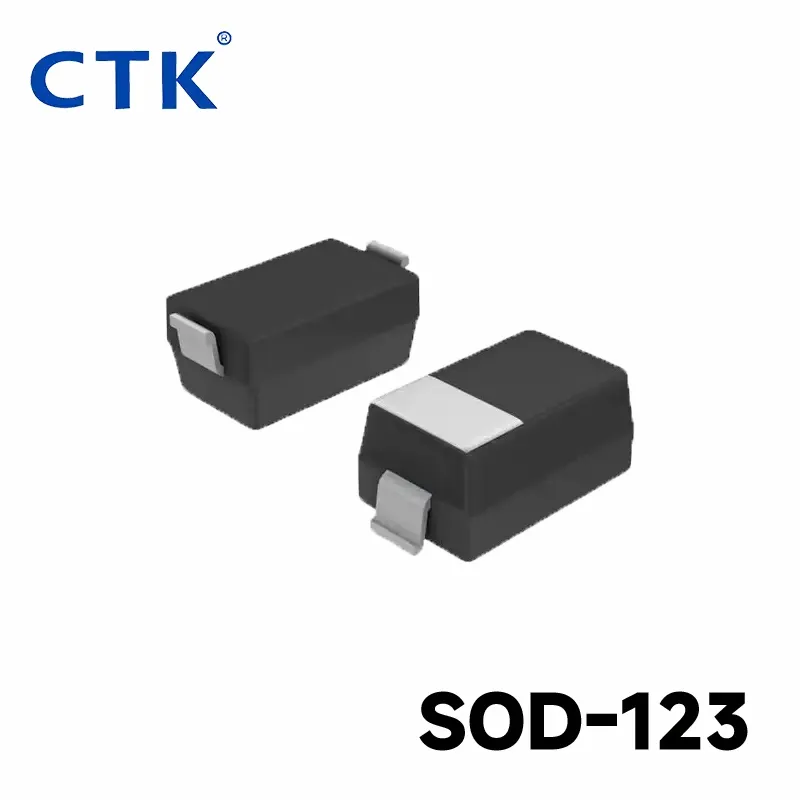
But let’s not ignore the alternatives. If your power supply is moderately powered (say, 20-50W), you might be wondering if SOD-323 is the right call, or if a slightly larger package is better. SOD-123 plastic-encapsulate zener diodes, for example, have a power rating of 1W, which is double that of SOD-323, so they can handle more current without overheating. They’re only slightly larger, so if board space is still available, they might be a safer choice for moderately powered supplies. But if space is your top priority, and your power supply’s current draw is low enough (under 500mA for most zeners), SOD-323 is more than capable. I always tell engineers to run a quick thermal simulation before choosing: calculate the power dissipation of the zener in your circuit, derate it by at least 20%, and check if that falls within the SOD-323’s rating at your operating temperature. If it does, it’s a solid choice.
One common mistake I see is using SOD-323 zeners for linear power supplies, which are simpler than switching power supplies but can have higher ripple voltage if the zener isn’t sized correctly. Linear supplies rely on the zener to maintain a constant voltage across the output, so any fluctuation in input voltage or current will be regulated by the zener. For linear power supplies, SOD-323 works well for low-current outputs (under 1A), but switching power supplies, which are more efficient and more common in modern electronics, actually work better with SOD-323. Switching supplies have smaller voltage fluctuations than linear supplies, so the zener doesn’t have to work as hard to keep the voltage stable, which plays to SOD-323’s strengths: small size, low leakage, and adequate power handling for most low-power switching supplies.
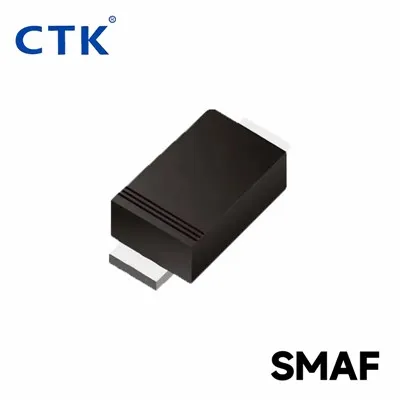
Let’s talk about a specific example: a 5V USB power supply for a smartwatch. Smartwatches use very little power—most models draw between 100mA and 500mA when charging. A SOD-323 zener rated for 0.5W at 5V would have a maximum current of 100mA at full power (since P=V*I, so I=0.5W/5V=0.1A). That’s more than enough for a smartwatch charger, and the small size means the charger can be smaller, lighter, and easier to carry in a pocket. Compare that to a SMAF silicon planar zener diode, which is a similar size but designed for slightly higher power, but would be overkill for a smartwatch charger and add unnecessary cost. It’s all about matching the component to the application.
Another consideration is voltage accuracy. SOD-323 zener diodes are available in tolerance grades from ±5% to ±2%, which is more than accurate enough for most power supply applications. For high-precision applications, like power supplies for medical devices that need to maintain a very consistent voltage for sensors, you might want a tighter tolerance, but even then, SOD-323 zeners have options for lower tolerances. The SMAF zeners I mentioned earlier also have tight tolerances, but again, that’s for higher-power or more precise high-current applications, not the compact power supplies where SOD-323 shines.
Now, let’s address the elephant in the room: reliability. No one wants a power supply that fails mid-use, especially if it’s in a critical device like a medical tool or a vehicle component. SOD-323 zener diodes are made with the same quality silicon as larger diodes, and they go through the same reliability testing: temperature cycling, humidity testing, and high-temperature operating life (HTOL) testing. As long as you choose a reputable supplier, the reliability is on par with larger packages, as long as you stay within the component’s rated limits. I’ve seen SOD-323 zeners work flawlessly in power supplies that have been in use for 5 years, because they were sized correctly for the application. The failures I’ve seen have always been from designers pushing the component beyond its limits—running too much current, operating at too high a temperature, or choosing a zener with the wrong voltage rating.
So, to circle back to the original question: are SOD-323 zener diodes for compact voltage control suitable for power supplies? The short answer is: yes, if your power supply is low-current, compact, and sized appropriately for the zener’s power rating. The long answer is: they’re one of the best options on the market for small, low-power power supplies, offering unmatched space savings and ease of assembly, as long as you respect their thermal limits and power rating. For high-power power supplies, stick to larger packages like LL-41 or SOD-123 zeners, but for everything from portable chargers to compact sensor power supplies, SOD-323 zeners will deliver consistent, reliable performance without eating up valuable board space.
If you’re still not sure whether SOD-323 zeners are the right fit for your power supply project, we can help. Whether you’re prototyping a new portable device, scaling up production of compact power supplies, or just need advice on selecting the right zener for your design, our team has years of experience working with diode components for power management. We offer a full range of zener diodes, from the compact SOD-323 series to higher-power packages, so you can find the exact component that matches your application’s needs. To discuss your project and get a quote, reach out to our team to learn more.
References
- "Zener Diode Application Note: Power Supply Design for Portable Electronics," Semiconductor Components Industry Association, 2022.
- "Surface-Mount Diode Thermal Performance for Compact Power Supplies," Journal of Electronic Packaging, vol. 14, no. 3, 2021.
- "Silicon Planar Zener Diode Reliability Testing Standards," International Electrotechnical Commission (IEC) 60747-5-2, 2020.