

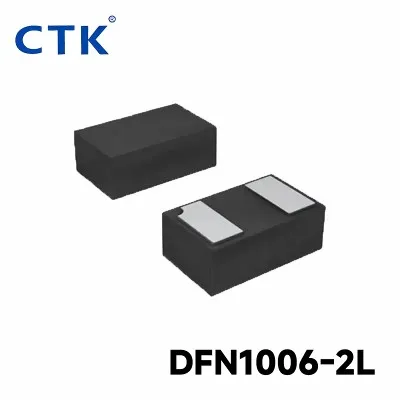



Small Power Crystal Diode
1. Identifying Positive and Negative Electrodes
(1) Observe the markings on the casing. A diode symbol is usually marked on the casing; the end with the triangular arrow is the positive terminal, and the other end is the negative terminal.
(2) Observe the colored dots on the casing. Point-contact diodes usually have polarity colored dots (white or red) on their casings. Generally, the end with the colored dot is the positive terminal. Some diodes also have color rings; the end with the color ring is the negative terminal.
(3) Using the measurement with the lower resistance value as the standard, the end connected to the black probe is the positive terminal, and the end connected to the red probe is the negative terminal. (d) Observe the diode casing; the end with the silver band is the negative terminal.
2. Detecting the Maximum Reverse Breakdown Voltage. For alternating current, because it is constantly changing, the maximum reverse working voltage is the peak AC voltage that the diode can withstand.
Bidirectional Trigger Diode
Set the multimeter to the appropriate DC voltage range; the test voltage is provided by a megohmmeter. During testing, shake the megohmmeter and measure the VBR value using the same method. Finally, compare VBO with VBR; the smaller the absolute difference between the two, the better the symmetry of the tested bidirectional trigger diode.
Transient Voltage Suppressor Diode (TVS) For unipolar TVS diodes, use a multimeter to measure their forward and reverse resistances, similar to measuring ordinary diodes. Generally, the forward resistance is around 4kΩ, and the reverse resistance is infinite.
For bipolar TVS diodes, the resistance between the two leads should be infinite regardless of whether the red and black probes are reversed. Otherwise, the diode is faulty or damaged.
High-Frequency Variable Resistor Diode The difference between a high-frequency variable resistor diode and an ordinary diode is the color code. Ordinary diodes typically have a black color code, while high-frequency variable resistor diodes have a light-colored color code. Their polarity is similar to ordinary diodes: the end with the green ring is the negative terminal, and the end without the green ring is the positive terminal.
Varactor Diode: When measuring a varactor diode, reverse the red and black probes of the multimeter. The resistance between the two leads of the varactor diode should be infinite. If, during measurement, the multimeter pointer swings slightly to the right or the resistance is zero, it indicates that the varactor diode has a leakage fault or is short-circuited.
Monochrome LED: Connect an energy-saving 1.5V dry cell battery to the multimeter and set the multimeter to the R×10 or R×100 range. This connection is equivalent to providing the multimeter with a 1.5V voltage in series, increasing the detection voltage to 3V (the turn-on voltage of the LED is 2V). During testing, alternately touch the two leads of the LED with the two multimeter probes. If the diode is functioning well, it will light up normally at least once. In this case, the lead connected to the black probe is the positive terminal, and the lead connected to the red probe is the negative terminal.
Infrared LED: 1. Identify the positive and negative electrodes of an infrared LED. Infrared LEDs have two leads; usually, the longer lead is the positive terminal, and the shorter lead is the negative terminal. Because infrared LEDs are transparent, the electrodes inside the casing are clearly visible. The wider and larger internal electrode is the negative electrode, and the narrower and smaller one is the positive electrode.
2. First, measure the forward and reverse resistance of each infrared LED. The forward resistance should typically be around 30kΩ, and the reverse resistance should be above 500kΩ for the LED to function properly.
Infrared Receiving Diode
1. Identifying Pin Polarity
(1) Visual Identification. Common infrared receiving diodes are black. When identifying the pins, facing the light-receiving window, from left to right, they are the positive and negative electrodes. Additionally, there is a small beveled surface at the top of the infrared receiving diode; usually, the pin with this beveled surface is the negative electrode, and the other end is the positive electrode.
(2) First, use a multimeter to check the positive and negative electrodes of a common diode. That is, swap the red and black probes and measure the resistance between the two pins twice. Normally, the resistance values should be one large and one small. 1. Using the smaller resistance value as the reference, the pin connected to the red probe is the negative terminal, and the pin connected to the black probe is the positive terminal.
2. Testing performance. Use a multimeter in resistance mode to measure the forward and reverse resistance of the infrared receiving diode. The magnitude of the forward and reverse resistance values can provide a preliminary indication of the diode's condition.
Laser Diode: The pin arrangement of the laser diode can be determined using the same method as testing the forward and reverse resistance of a regular diode. However, it's important to note that because the forward voltage drop of a laser diode is larger than that of a regular diode, the multimeter pointer will only deflect slightly to the right when testing the forward resistance.