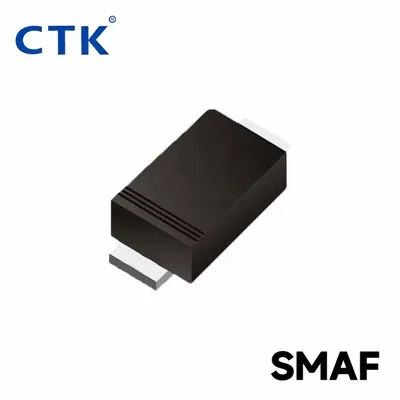






Hey there! As a supplier of DIODE SOD - 123FL Package Rectifier Diodes, I often get asked about the reverse recovery charge at different currents. So, I thought I'd write this blog to break it down for you.
Let's start with the basics. A rectifier diode is a semiconductor device that allows current to flow in one direction only. It's a crucial component in power supplies, voltage regulators, and many other electronic circuits. The DIODE SOD - 123FL Package Rectifier Diodes are popular because of their small size and high - efficiency performance.
What is Reverse Recovery Charge?
The reverse recovery charge ($Q_{rr}$) is a parameter that measures the amount of charge that flows in the reverse direction when a diode switches from the forward - conducting state to the reverse - blocking state. When a diode is forward - biased, there are a lot of carriers (electrons and holes) in the depletion region. When you suddenly reverse the bias, these carriers don't just disappear instantly. They continue to flow for a short period, creating a reverse current. The total charge associated with this reverse current is called the reverse recovery charge.
Reverse Recovery Charge at Different Currents
The reverse recovery charge of a diode can vary significantly depending on the forward current flowing through it before the commutation.
Low Forward Currents
At low forward currents, the number of carriers injected into the depletion region is relatively small. When the diode switches to the reverse - biased state, there are fewer carriers to be removed. As a result, the reverse recovery charge is also low. For example, when the forward current is around 100 mA, the reverse recovery charge of our DIODE SOD - 123FL Package Rectifier Diodes might be in the range of a few nanocoulombs. This low reverse recovery charge is beneficial in circuits where switching losses need to be minimized, such as low - power DC - DC converters.
Medium Forward Currents
As the forward current increases to a medium level, say around 500 mA, the number of carriers in the depletion region increases. When the diode switches to the reverse state, more carriers need to be removed, leading to a higher reverse recovery charge. The reverse recovery charge might increase to tens of nanocoulombs. In applications like medium - power battery chargers, this increase in reverse recovery charge needs to be taken into account as it can contribute to additional power losses.


High Forward Currents
At high forward currents (e.g., 1 A or more), the reverse recovery charge can be significantly higher. The large number of carriers injected during forward conduction results in a substantial reverse current during the reverse recovery process. The reverse recovery charge can reach hundreds of nanocoulombs. In high - power applications such as motor drives, this high reverse recovery charge can cause problems like increased electromagnetic interference (EMI) and higher power dissipation in the diode.
Comparison with Other Rectifier Diodes
It's always good to compare our DIODE SOD - 123FL Package Rectifier Diodes with other types of rectifier diodes in terms of reverse recovery charge.
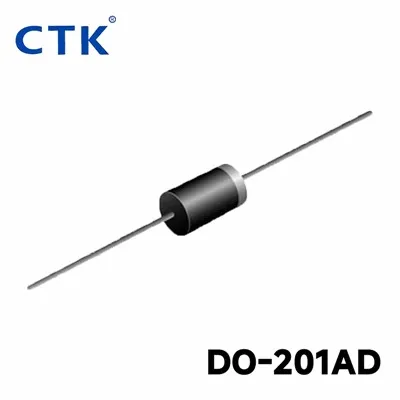
DO - 201AD Rectifier Diodes General Purpose Rectifier are larger in size compared to our SOD - 123FL package. They are designed for general - purpose applications and can handle relatively high currents. However, their reverse recovery charge is often higher than that of our SOD - 123FL diodes, especially at lower currents. This means that in low - power and high - frequency applications, our DIODE SOD - 123FL Package Rectifier Diodes can offer better performance.
SMA Rectifier Diodes Surface Mount General Purpose Silicon Rectifier and SMC Rectifier Diodes Surface Mount General Purpose Silicon Rectifier are also popular surface - mount rectifier diodes. Their reverse recovery characteristics are different from our SOD - 123FL. The SMA and SMC diodes are often used in medium - power applications where a slightly larger package can tolerate more heat. Our SOD - 123FL diodes, on the other hand, are better suited for space - constrained applications where low reverse recovery charge is also important.
SMBF Rectifier Diodes Surface Mount General Purpose Silicon Rectifier have a similar form factor to our SOD - 123FL but may have different electrical characteristics. The SMBF diodes might be more optimized for certain voltage and current ranges. However, our DIODE SOD - 123FL Package Rectifier Diodes offer a unique balance between size, reverse recovery charge, and cost.
DO - 41 Rectifier Diode is an old - fashioned through - hole rectifier diode. It can handle relatively high currents but is larger in size. Its reverse recovery charge is also relatively high compared to our SOD - 123FL diodes, making it less suitable for modern high - frequency and low - power applications.
Why Choose Our DIODE SOD - 123FL Package Rectifier Diodes?
Our DIODE SOD - 123FL Package Rectifier Diodes offer several advantages. Firstly, their small size makes them ideal for compact electronic devices. Secondly, they have a relatively low reverse recovery charge, especially at low and medium currents. This means that they can reduce switching losses and improve the efficiency of your circuits. Thirdly, we offer high - quality products with consistent electrical characteristics, which ensures the reliability of your electronic systems.
If you're in the market for rectifier diodes and are interested in learning more about how our DIODE SOD - 123FL Package Rectifier Diodes can meet your needs, feel free to reach out to us for a quote and a detailed discussion. Our team of experts is always ready to assist you in making the right choice for your applications.
References
- Semiconductor Physics and Devices by Donald A. Neamen
- Power Electronics: Converters, Applications, and Design by Ned Mohan, Tore M. Undeland, and William P. Robbins
- Diode Data Sheets from various semiconductor manufacturers.